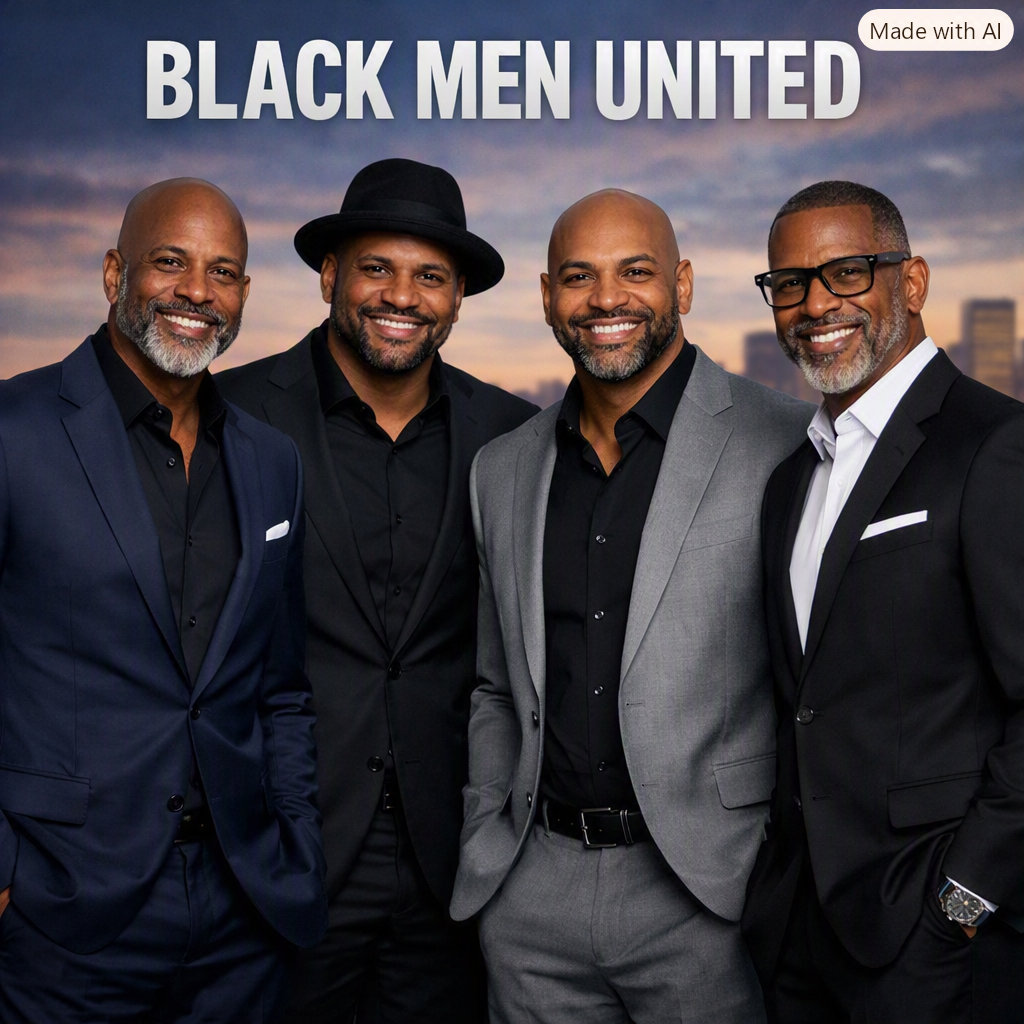
Four Black Entrepreneurs You Need to Know Before They Take Over the Room By Charles Zackary King | America in Black and White | Season 4, Episode 135 WEDNESDAY, AUGUST 26, 2026 Left to right — Evan Campbell, Wendell Holton, Leonard King, and Frederick Anthony “Tony” Magby. Together, they are “Black Men United.” THE HOOK There is a lie that has been told so many times, in so many rooms, by so many mouths, that it has almost calcified into truth: that Black men don’t support each other. That they compete instead of collaborate. That the scarcity mindset runs so deep that there is no room at the table for a brother pulling up a chair. It is a lie and tonight, on a single episode of America in Black and White, four men are going to blow it apart, chapter by chapter, story by story, dollar by dollar. When four Black entrepreneurs sit at the same table, something shifts in the atmosphere. Not because of the industries they represent, though those are remarkable. Not because of the credentials they carry, though those are earned. But because of what it means when men who could be running in isolation choose instead to run together. They choose to be honest about the road. They choose to name the obstacles, share the blueprints, and refuse to let the next generation figure it out alone. That is what Black Men United looks like in practice. Not a slogan. An action. America in Black and White, the podcast and digital media platform hosted by Charles Zackary King, has never shied away from the conversations that matter most, the ones about legacy, community, economic power, and what it truly costs to build something from the ground up in this country. And on Wednesday, August 26, 2026, at 6:00 PM EST, Season 4, Episode 135 brings together four builders whose stories will make you rethink everything you thought you knew about what Black entrepreneurship looks like today. Tonight’s table is not just carrying resumés. It is carrying decades of sacrifice, quiet mornings before the rest of the world woke up, decisions made in the dark before the outcome was visible. It is carrying strategies you can use, wisdom you have been waiting for, and a spirit that this culture desperately needs right now. Pull up. This one is for all of us. WHY THIS EPISODE MATTERS For too long, the full complexity of Black men, as thinkers, as builders, as fathers, as mentors, as visionaries, as entrepreneurs, has been compressed into a single story. This episode refuses that compression. What you will witness in Season 4, Episode 135 is Black men in their full humanity: honest about their failures, clear-eyed about their missions, and deeply, deliberately committed to something larger than themselves. This is not a performance. This is a reckoning with what it means to build and to build well. The philosophical spine of this episode is rooted in a Desmond Tutu Black History Reflection and the Ubuntu principle, I am because we are. Ubuntu is not a sentiment. It is an architecture. It says that a person’s humanity is inextricably bound to the humanity of those around them. That no one rises alone. That the brother who succeeds strengthens the ground beneath every other brother still climbing. The themes that anchor this episode, Unity, Community Building, Brotherhood, Legacy, and Entrepreneurship, flow directly from that root. This is not just a podcast. It is a movement taking shape in real time, one honest conversation at a time. And at the center of that movement tonight are four men who have each built something worth talking about. Something worth studying. Something worth protecting. Allow us to introduce them properly, because they deserve more than a bio. They deserve a story. MEET THE MEN AT THE TABLE Evan Campbell-E&V Auto Evan Campbell, Founder of E&V Auto Before Evan Campbell ever picked up a wrench, he watched his mother hold a world together with quiet, unbreakable hands. She did not speak in grand declarations. She demonstrated. She showed up. And in that showing up, she handed her son something no classroom could give him: the understanding that resilience is not a feeling, it is a practice. It is the discipline of choosing, every single day, to keep going even when the outcome is uncertain. Evan carried that lesson into every garage, every engine, every negotiation. It became the foundation of everything he would build. But Evan was also a student of history and history radicalized his ambition. He found Malcolm X not as a distant figure but as a living instruction: know yourself, own your space, refuse to build someone else’s empire at the expense of your own. He found Alonzo Herndon, Atlanta’s first Black millionaire, who walked out of enslavement with eleven dollars and proceeded to build an insurance empire that served an entire people. Herndon did not wait for permission. He did not wait for favorable conditions. He identified a need in his community and became the answer. Evan saw that blueprint and recognized it immediately, because he had already started drawing his own version of it. The automotive industry, Evan understood early, is not merely a trade. It is territory. And Black men needed to own it. E&V Auto is not just a business, it is a declaration of economic sovereignty built through skilled craftsmanship and the refusal to let technical excellence remain someone else’s domain. When you hand a wrench to a man who understands what ownership means, you are not watching someone fix a car. You are watching someone write his own future, one honest repair at a time. Evan’s belief is simple and profound: the tools you master are the tools that free you. In a country that has historically tried to control the economic mobility of Black men by limiting their access to skilled trades, mastery becomes more than competence, it becomes resistance. Evan Campbell is building a legacy