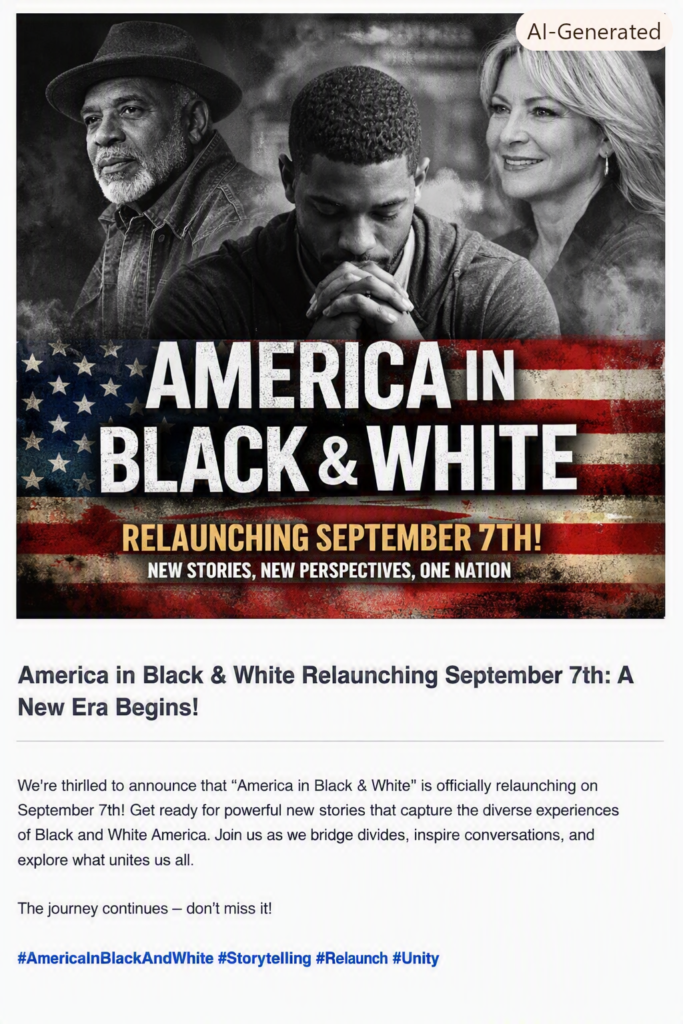
We’re Back And This Time,We’re Not Whispering.
America in Black and White returns September 7th with three powerful shows, one unapologetic mission, and a digital home built for you. There has never been a shortage of Black stories in America. What’s been scarce, painfully, frustratingly scarce, is the space to tell them honestly, in our own voices, on our own terms. For too long, Black American culture, history, and community have been filtered through someone else’s lens. Watered down. Repackaged. Misrepresented. Or worse, ignored altogether. The headlines talk about us. The panels debate us. But rarely do they sit down with us, dig in with us, laugh and grieve and push forward with us. That’s the gap. That’s always been the gap. And that’s exactly what America in Black and White was built to fill. We took some time. We regrouped, rebuilt, and came back with something stronger, sharper, and more intentional than ever before. On September 7, 2026, the relaunch is official. Three shows. One destination. An entire ecosystem built around the truth, told the way it deserves to be told. Welcome back. Or maybe, for the first time: welcome home. What Is America in Black and White? America in Black and White (AMIBW) is more than a show. It’s a multimedia storytelling brand rooted in the richness of Black American culture, the weight of Black American history, and the daily, living, breathing reality of Black American community. This is not commentary from a distance. This is conversation from the inside, with the people who are living it, shaping it, and pushing it forward. At AMIBW, we believe the truth is worth saying out loud. We believe culture is worth celebrating without apology. We believe that the stories that don’t make the evening news are often the most important ones to hear. Whether we’re unpacking a headline, lifting up a voice, revisiting a moment in history, or just talking about what’s really happening in our neighborhoods and our lives, you will always find honesty here. You will always find respect here. And you will always find a seat at the table. “This isn’t commentary from a distance. This is conversation from the inside and you’re always welcome here.” Three Shows. One Powerful Voice. The AMIBW relaunch isn’t just one show coming back, it’s an entire ecosystem of programming designed to meet you wherever you are in the conversation. Three distinct shows. Three distinct formats. One unified mission. Show Schedule Format America in Black and White (AMIBW) Monday, Wednesday & Friday Flagship — current events, culture, community Changing Trends and Times (CTT) Saturdays at 3 PM EST Deep-dive roundtables & trend analysis CK Stories from the Heart Sundays at 3 PM EST Personal narrative & human storytelling America in Black and White — Mon / Wed / Fri The flagship. The foundation. AMIBW airs three times a week and covers the full landscape — current events, culture, community conversations, and everything in between. This is where we take the news of the day and ask the questions other shows are afraid to ask. This is where Black America gets to speak first, not last. Expect honesty, depth, and the kind of energy that keeps you coming back Monday, Wednesday, and Friday without fail. Changing Trends and Times (CTT) — Saturdays at 3 PM EST Every Saturday, we go deeper. CTT is your long-form, roundtable destination — the show where we slow down and actually examine the forces shaping Black America right now. Economic shifts. Social movements. Cultural evolution. Generational change. We bring in sharp minds, real perspectives, and the kind of conversation that challenges you to think differently. Saturday afternoons just got a whole lot more interesting. CK Stories from the Heart — Sundays at 3 PM EST Sunday is for the soul. CK Stories from the Heart is the show that reminds you why storytelling matters in the first place. Personal. Human. Real. These are the stories that move you, the ones that make you nod, make you tear up, make you call somebody you haven’t talked to in a while. Hosted by CK himself, this show is where vulnerability meets strength, and where every story is told with the reverence it deserves. Start your week right. End your weekend with something that means something. “Three times a week, we take the news of the day and ask the questions other shows are afraid to ask.” Your New Digital Home The relaunch isn’t just about what’s on air, it’s about where you go between episodes. americainblackandwhite.us has been rebuilt as a full destination: a place to listen, watch, connect, engage, and belong. Think of it less like a website and more like a community hub that happens to live online. Visit the site: americainblackandwhite.us Everything you need — shows, membership, the Decast player, Spotify links, and the YouTube channel — all in one place. This is your home base. What’s Coming in October The September 7th relaunch is just the beginning. Starting in October, AMIBW introduces monthly theme programming, a curated, intentional way of going deeper into the conversations that matter most. Each month, all three shows will weave around a central theme, creating a connected, layered experience that builds across episodes and formats. We’re not ready to reveal the October theme just yet and honestly, the anticipation is part of the experience. What we can tell you is this: it will be timely, it will be necessary, and it will be exactly the kind of conversation that Black America has been waiting to have at scale. When the theme drops, you’ll understand immediately why we chose it. Mark your calendar. Follow the site. Stay close. “Starting in October, every episode, every show, every conversation becomes part of something bigger.” How to Be Part of It This isn’t a show you watch from the sidelines. AMIBW is a community and communities are built by the people who show up. Here’s how you can be part of it from day one: September 7, 2026. Mark it.