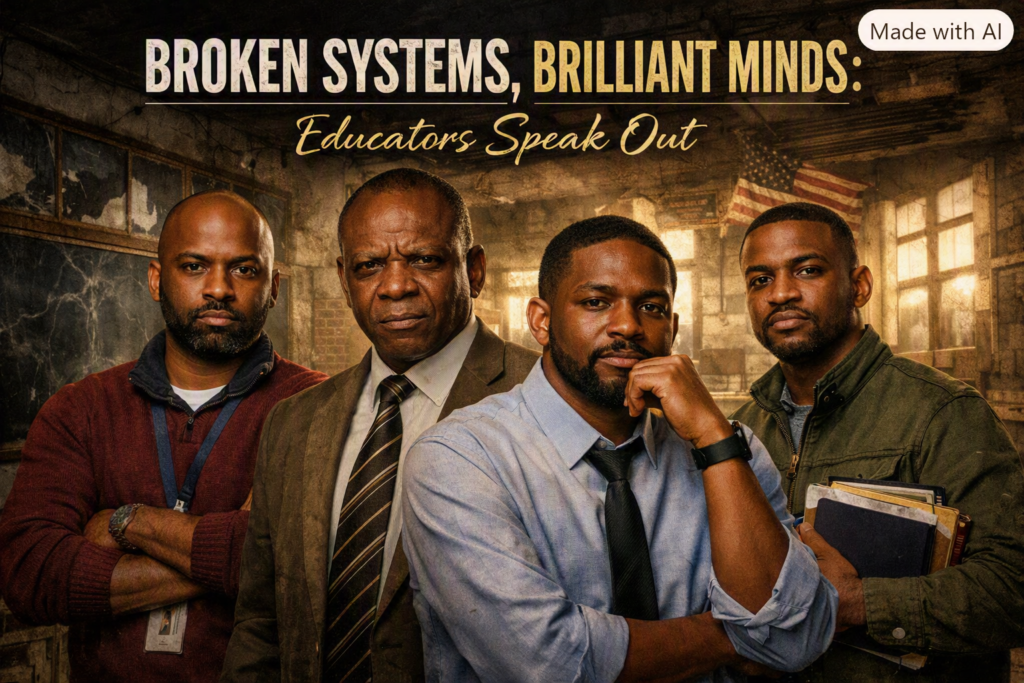
Broken Systems, Brilliant Minds: Why America’s Educators Are Speaking Out
Published by America in Black and White (AMIBW) | Host: Charles Zackary King | August 31st Special Edition A Nation’s Children Are Waiting for Adults to Tell the Truth Right now, in schools across this country, a child is sitting in a classroom that does not see them. Not truly. The textbooks do not reflect their history. The standardized tests do not account for the gaps the system itself created. The teachers, through no entirely personal fault, do not always know how to reach them. And the administrators who could change the culture at scale are, too often, a demographic mirror of a past that was never meant to include that child in the first place. This is the state of American public education for Black, brown, immigrant, and low-income students. It is not a tragedy to be lamented in passing. It is a crisis to be named, confronted, and dismantled with precision and that is exactly what four extraordinary educators are prepared to do on August 31st, when America in Black and White airs its most urgent special edition yet: Broken Systems, Brilliant Minds: Educators Speak Out. These are not commentators. These are not policy theorists writing from the comfort of a think tank. These are people who have walked into the building, sat with the data, built the programs, written the books, and stood in the rooms where the decisions get made, sometimes as the only Black face at the table. What they have to say is not comfortable. It is necessary. The Moment That Matters Most: Sixth Grade and the Dropout Clock Dr. Jonathan A. Brown has spent his career in the middle, literally. As principal of Longfellow Middle School in the Mount Vernon City School District in New York, and as the author of a landmark doctoral dissertation that examined twenty-one sixth-grade schools across Westchester County, Dr. Brown has done something the broader education reform conversation rarely does: he has looked squarely at the grade-level moment where everything begins to turn. His research, conducted at St. John Fisher College, identified sixth grade as what he calls the “keystone grade”, the absolute center of a student’s public school journey, the grade where college readiness indicators first become visible, and where the risk of eventual dropout can be tracked with statistical clarity. This is not a metaphor. It is a finding rooted in descriptive statistics, correlation matrices, and regression analysis across more than two dozen schools. What Dr. Brown discovered is that the way a school organizes its curriculum, instruction, and assessment in sixth grade, what he terms the CIA cluster, has a statistically significant impact on student achievement. The systems we design for eleven-year-olds are not preparatory. They are, in many ways, determinative. And far too many schools are still guessing. When we talk about the achievement gap, we are almost always talking about it too late. Dr. Brown forces us to look earlier, act faster, and build schools that understand the particular developmental urgency of young adolescents between ten and fourteen years old. If that window closes without the right intervention, the clock does not reset. When 94% of Students Fail, the Problem Is Not the Students Dr. Shaquille Spearman does not allow us the comfort of ambiguity. His doctoral research at Liberty University examined one specific school, Jacksonville Lighthouse Charter School – College Prep Academy in Jacksonville, Arkansas and one specific problem: why, in 2022, 137 out of 146 students in grades 7 through 10 failed to meet the math readiness benchmark on the ACT Aspire. That is approximately ninety-four percent. Nearly every child. Failing a benchmark that will follow them for the rest of their academic lives. Dr. Spearman’s research revealed that the failure was not the students’. It was the system’s. Teachers were not provided with detailed reporting categories. Professional Learning Communities “PLCs”, were new and underdeveloped, leaving educators without the collaborative infrastructure to respond to data. Students were arriving in math classrooms underprepared for the literacy-driven demands of standardized questions. Administrators were rated at 1.7 out of 5 in their use of data mining. These are not anecdotes. These are measurements and they demand a systems-level response, not another round of blaming children who were never given a fair chance. Dr. Spearman’s framework, drawing on Feuerstein’s Structural Cognitive Modifiability, Bloom’s Taxonomy, and metacognitive strategy, insists that students are capable of far more than their test scores suggest, provided that teachers are trained to reach them and systems are designed to support that reach. The crisis at Jacksonville Lighthouse is not an outlier. It is a window into what is happening, quietly, in charter schools and public schools nationwide. Someone has to say it. Dr. Spearman did. Literacy Is Not a Metric — It Is a Matter of Survival In Oshkosh, Wisconsin, Dr. Samuel Coleman is building something that the education system rarely builds on purpose: a community literacy infrastructure that is explicitly designed for the students the system has historically ignored. As Assistant Superintendent of Instruction for the Oshkosh Area School District and Co-Founder of READ MORE Oshkosh, Dr. Coleman has spent his career at the intersection of literacy, leadership, and liberation, three words that are not coincidental. Dr. Coleman, who holds a Ph.D. and M.S. from the University of Wisconsin-Madison, an M.Ed. from LSU-Shreveport, an M.S. in School Counseling from Concordia University, and is currently completing an Ed.M. at Harvard University, speaks with the authority of someone who has been both the student underestimated by a system and the administrator working to change it from within. His READ MORE Oshkosh initiative was built specifically for Black, immigrant, and refugee students, communities for whom literacy has always been more than an academic exercise. It has been a means of claiming personhood, access, and power in a society that has used illiteracy as a tool of control. “Representation matters,” he has said. “And not just for Black students, but all students need to see diversity represented in the materials that they read,